
The square flanked by the Museo Diocesano di Cortona and the Duomo di Cortona offers one of the most extraordinary views in Cortona: the landscape opens toward Lake Trasimeno in a succession of light, color, and natural distances that the painter Piero Dorazio described as a “keyboard of sensations.”
Within this balance between architecture and landscape, one can understand the formation of Severini’s gaze: a light that “paints all day long,” shifting among silvery tones, greens, blues, and the magentas of sunset.
The Diocesan Museum houses fundamental masterpieces of Tuscan painting — from Beato Angelico to Pietro Lorenzetti — works that helped shape the sensibility of the young artist.
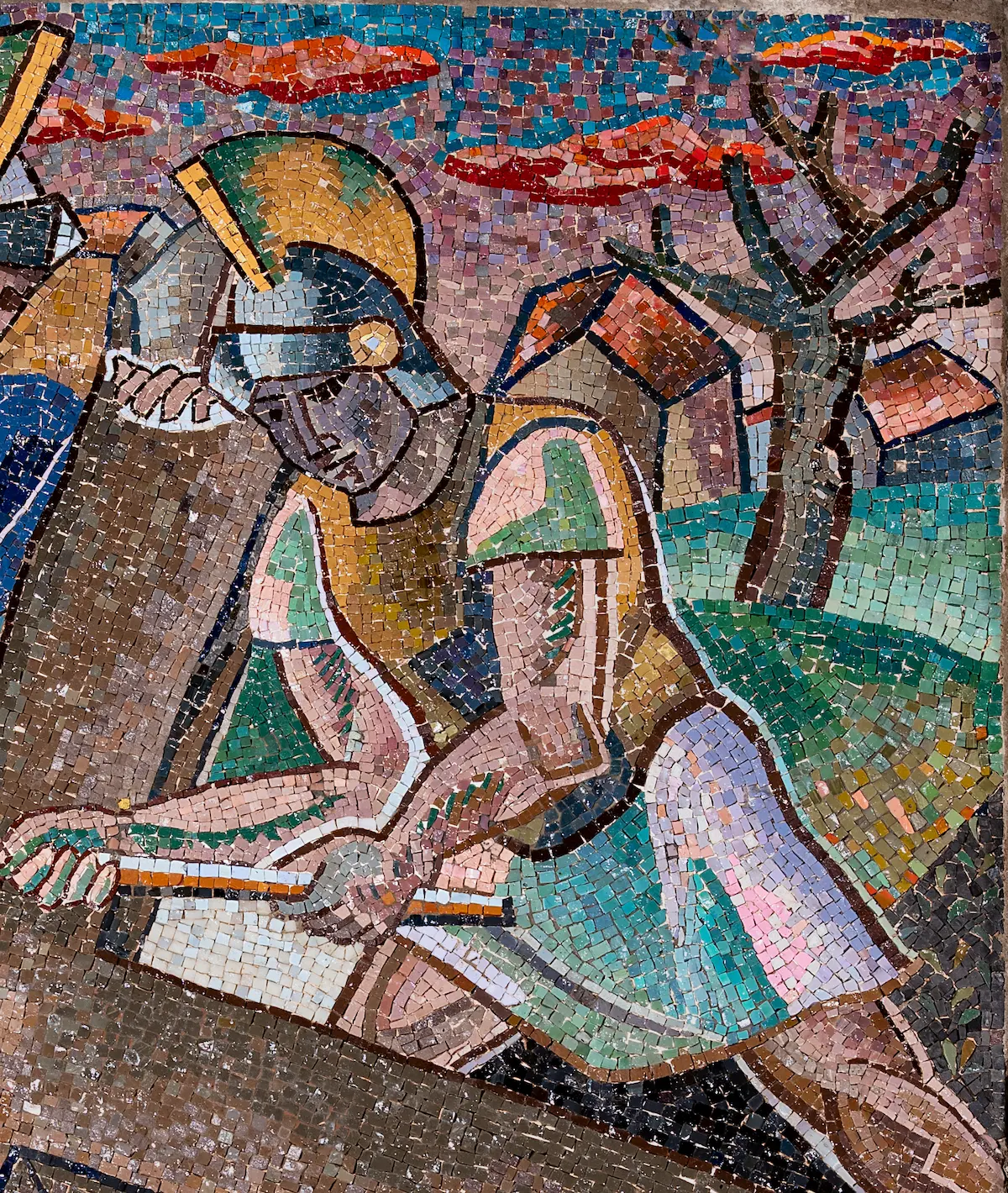
Inside the Cathedral is preserved one of Severini’s most intense interventions: the Via Crucis in mosaic, created in the 1940s under his direct supervision. The figures, defined by vigorous contours and strong narrative unity, unfold as a sacred representation in which the city itself seems to recognize its own rooftops in the background profiles.
In the left nave stands the Sacred Heart (c. 1955), a mosaic entirely executed by the artist and donated to his fellow citizens — a work that unites iconographic tradition with vibrant chromatic energy.
This stage reveals the profound dialogue between Severini, spirituality, and the light of Cortona.