
Among the masterpieces of the MAEC
The Tabula Cortonensis is on display at the MAEC in Cortona. It is an almost complete text written in the Etruscan alphabet: a contract recording the sale of land to the Cusu family by an oil merchant and his wife.
It is one of the longest Etruscan texts known, which accounts for its great importance. The tablet is engraved on bronze, dates to the 3rd–2nd century BCE, and offers a remarkable glimpse into Etruscan legal and social life.
Among the masterpieces of the MAEC
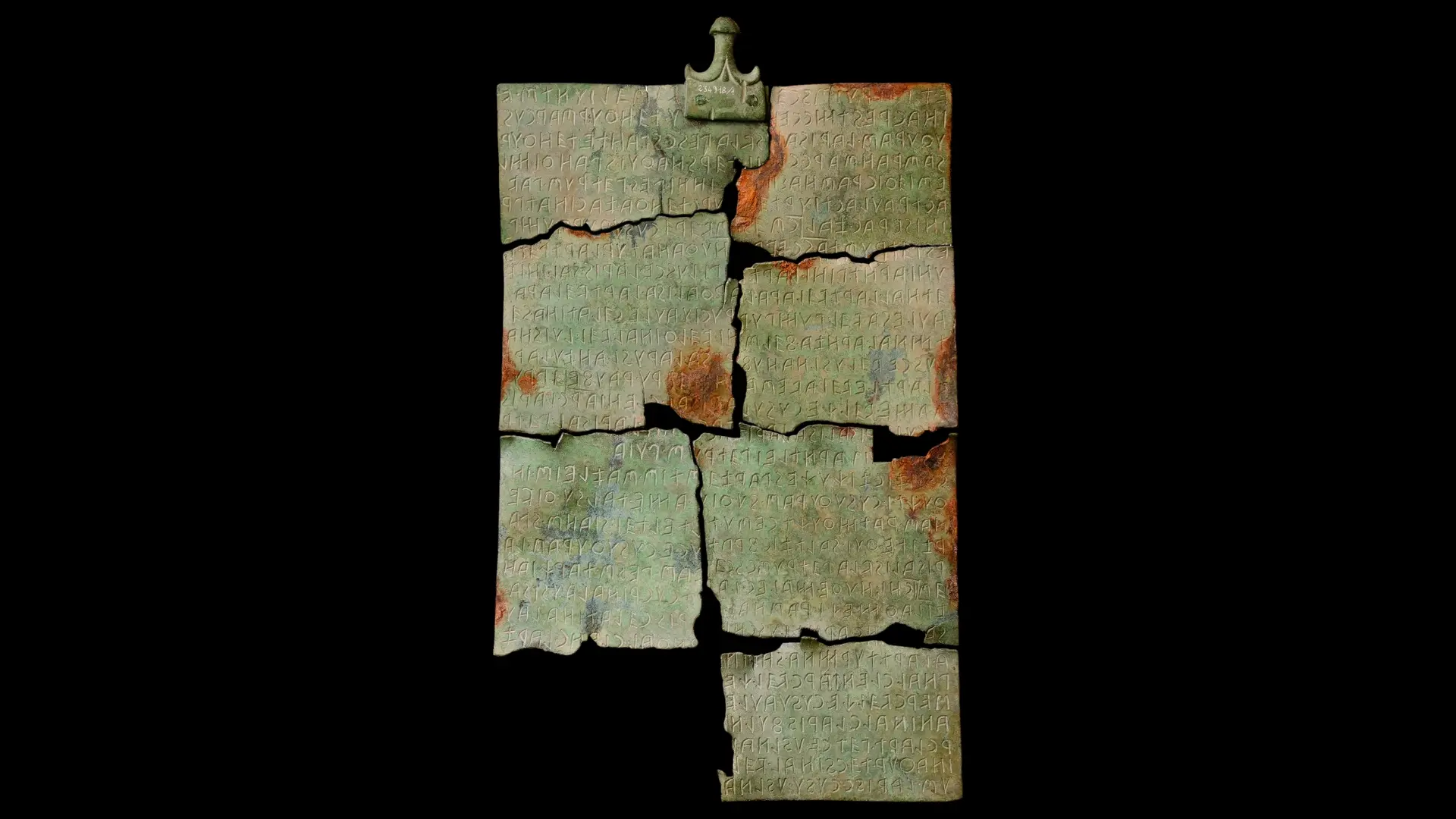
The Tabula Cortonensis is on display at the MAEC in Cortona. It is an almost complete text written in the Etruscan alphabet: a contract recording the sale of land to the Cusu family by an oil merchant and his wife.
It is one of the longest Etruscan texts known, which accounts for its great importance. The tablet is engraved on bronze, dates to the 3rd–2nd century BCE, and offers a remarkable glimpse into Etruscan legal and social life.
We might never have seen it
It is believed that in antiquity the tablet was displayed in a public place, perhaps a sanctuary, and hung on a rail that allowed it to be read on both the front and the back.
Later, once it had lost its original function, it was broken into eight pieces and destined to be melted down so that the valuable bronze could be reused. The fragments were stored in a damp environment together with other iron objects; for this reason, iron stains and encrustations can still be seen in several areas.
We might never have seen it
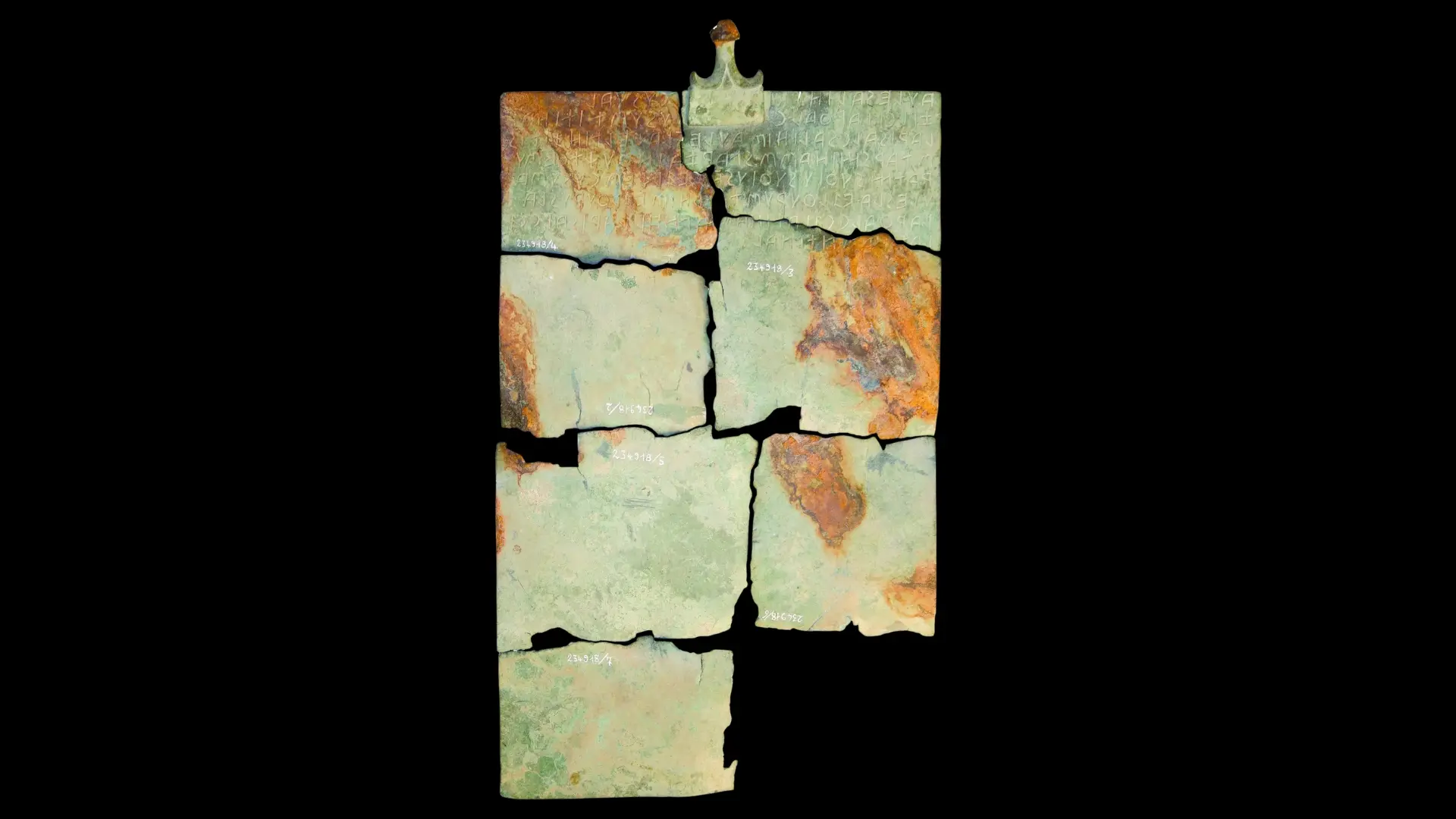
It is believed that in antiquity the tablet was displayed in a public place, perhaps a sanctuary, and hung on a rail that allowed it to be read on both the front and the back.
Later, once it had lost its original function, it was broken into eight pieces and destined to be melted down so that the valuable bronze could be reused. The fragments were stored in a damp environment together with other iron objects; for this reason, iron stains and encrustations can still be seen in several areas.
Seven Surviving Fragments
The seven surviving bronze fragments once formed a rectangular tablet measuring 28.5 × 45.8 cm, bearing an inscription engraved with an extremely sharp burin.
The alphabet is the one used in the Cortona area between the late 3rd and the 2nd century BCE, recognizable by the reversed Ǝ, clearly visible in the document and later adopted in the logo of the MAEC.
Despite the loss of the eighth fragment, the text remains fortunately understandable.
Seven Surviving Fragments
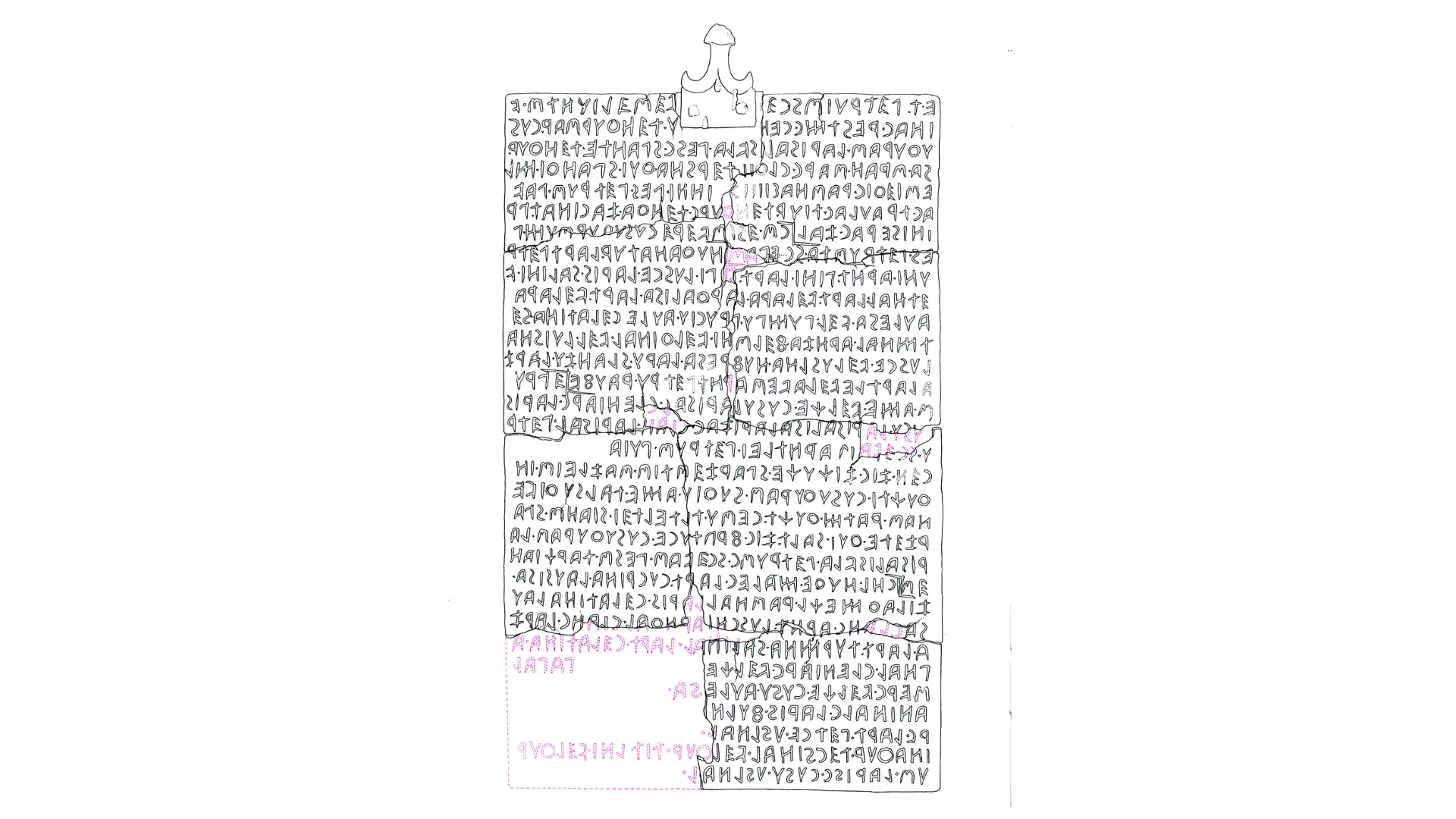
The seven surviving bronze fragments once formed a rectangular tablet measuring 28.5 × 45.8 cm, bearing an inscription engraved with an extremely sharp burin.
The alphabet is the one used in the Cortona area between the late 3rd and the 2nd century BCE, recognizable by the reversed Ǝ, clearly visible in the document and later adopted in the logo of the MAEC.
Despite the loss of the eighth fragment, the text remains fortunately understandable.
Discover more
During the Hellenistic period, between the late 4th and the 2nd century BCE, Cortona experienced a time of profound change: the Etruscans still spoke their own language, yet they increasingly adopted Roman customs and fashions. Discovered near the city, the Tabula Cortonensis records in Etruscan the sale of a piece of land. Now on display at the MAEC – Museo dell’Accademia Etrusca e della Città di Cortona, it stands as an extraordinary testimony to everyday life and to the cultural transition of that era.
In 1992, seven bronze fragments were handed over to the Carabinieri after being found at Le Piagge, near Camucia. These plates, bearing inscriptions on both sides, constitute the entire surviving document. With 40 lines and 206 words, it is the third longest known Etruscan text, after the so-called “Mummy of Zagreb” and the “Tabula Capuana. Two different hands can be identified: a principal scribe engraved the first 26 lines of the recto and the entire verso, while a secondary scribe added the final six lines of the recto.
The tablet is recognized as an important legal act, most likely concerning the sale of land, comparable to the Roman in iure cessio, in which the buyer formally claims property in the presence of the seller, a magistrate, and witnesses.
The contract is divided into seven sections:
- Petru Scevaś transfers land to the Cusu, sons of Laris, specifying measurements and exchanged goods.
- The Cusu consortium claims ownership of Petru Scevaś’s land.
- A group of 15 witnesses is listed, likely from different social ranks, with names and roles.
- The principal parties are recorded: Velche Cusu and his sons; Petru Sceva and his wife Arntlei.
- A probable reference is made to the official registration of the act, perhaps preserved in a sanctuary or archive.
- The magistrate (praetor) Lart Cucrina Lausisa, assisted by a council of 13 aristocrats, formalizes the purchase.
- Dating details and references to the tablet itself are included, mentioning lands near Lake Trasimeno and aristocratic family archives.
The inscription reveals political alliances and kinship ties between families. Numerous gentilicia and place names are connected to the Cusu,who also appear in funerary monuments in Cortona such as the Tanella Angori and the Tanella di Pitagora. Onomastic evidence suggests that, although of modest origins, the Cusurose within the aristocratic sphere through land transactions and strategic marriages. At least 32 men and 10 women are named, with varying formulae (two- or three-part names including gentilicum, cognomen, praenomen, and patronymic), allowing scholars to trace family and social networks linked to areas such as Cortona, Perugia, Chiusi, and Asciano. The Tabula thus reflects not only a legal transaction but also the political and territorial dynamics of the 2nd century BCE, in a period marked by the strengthening of local gentes and interregional alliances.